07
Marea Enmudecida
(Exhibition Text)
(4 photos / 1615 words)
(Exhibition at Nogueras Blanchard Barcelona)
(2023)

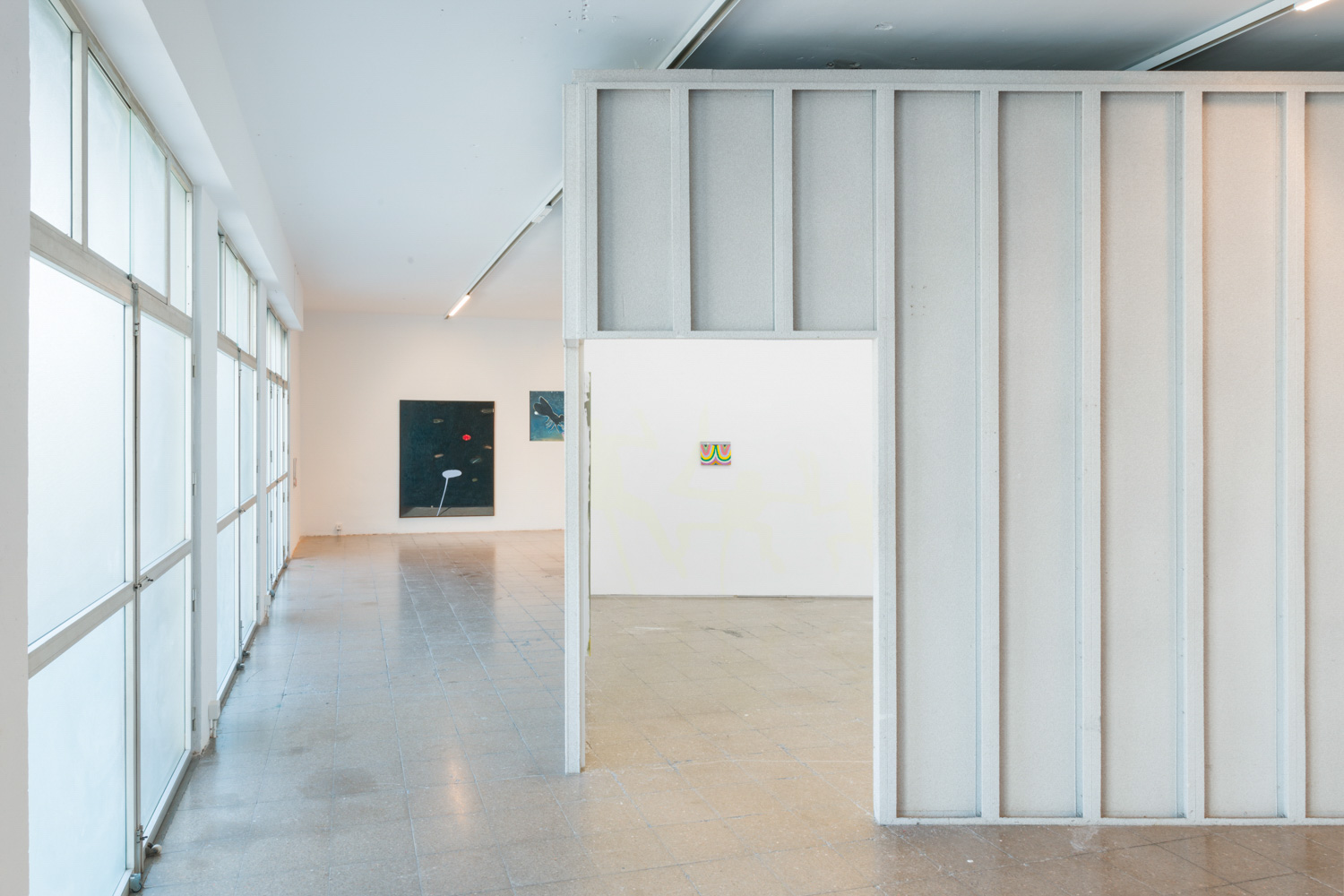
Vistas da Exposição "Marea Enmudecida" de Tiago Baptista.
Portuguese Version
Como falamos sobre aquilo que a linguagem não alcança?
No centro da tela amarela, um corpo flutua no espaço. Entre as pernas, o rabo do macaco faz o encontro do vácuo solar com a terra rosada. O animal desenha um
voo com o seu gesto, mas volta o seu olhar a nós. No seu rosto, projetamos o nosso desconforto diante de um animal que parece ter aprendido a mimetizar as nossas expressões. Seria esse um desconforto por estarmos diante de
um espelho quando olhamos para o animal?
Na pintura de Tiago Baptista, o encontro com o animal costuma irromper exigindo de nós alguma reflexão. Não são alegorias os macacos em suas danças, os caracóis em seus vagarosos andares e as conchas em seus segredos
sussurrados, mas antes presenças de algum significado que deixamos escapar pelo caminho.
br>To play at being human for a while — como canta Robert Wyatt em Sea Song, essas presenças surgem da sensibilidade
do artista em nos aproximar do entendimento daquilo que a linguagem não alcança. Em seu trabalho, a pintura desafia os limites da nossa capacidade de expressão verbal e não se deixa existir dentro do mesmo espaço cognitivo.
A pintura e a palavra não podem se encontrar — e isso exige de nós um olhar guiado pelo prisma da imaginação.
O calhau que repousa sobre um arco-íris subterrâneo, a tartaruga que dorme um sono de duzentos anos, a fala
emudecida que olha o crepúsculo azul, a concha espiral que projeta a sombra da sua existência contra o vazio rosáceo, os pelos negritos que rasgam o solo da caverna para nascer, a orelha que escuta os sussurros das pedras,
juntas essas presenças formam um canto consciente de si mesmo. Um coro que, ao cantar uma música de fundo para a eterna procura da humanidade por si mesma, canta também a história das imagens nascidas dos poros da terra, das
palavras nascidas dos buracos da cabeça, da linguagem nascida do sopro de um desejo. Da pintura em eterna negociação com as palavras. A pintura é, aqui, o gesto primário.
De nós, é exigida a observação prolongada das
obras que constituem esta exposição. Somente por uma paciente permanência do olhar em conversa com o pensamento é que descobrimos as brechas para, como fazem os olhos intrusos na obra The Tell-Tale Heart de Odilon
Redon, acessar ao universo secreto que se cria a partir do trabalho de Tiago Baptista. Um universo onde as suas presenças participam de uma conversa emudecida pela distância do tempo, ou pela distância da linguagem. Uma conversa
que, apesar de não podermos ouvir, nos fala através de outra ordem — pois a natureza da pintura não é da mesma ordem da natureza da linguagem.

Vistas da Exposição "Marea Enmudecida" de Tiago Baptista.
Situar a sua prática e o seu pensamento pictóricos fora da lógica das palavras e da linguagem é um exercício que vem sido aprimorado pelo artista ao longo de seu percurso. O meio para realizá-lo passa, muitas vezes, pela experiência
de testar os limites da própria prática da pintura, de expandi-la — sabendo que, se for preciso, é sempre possível recuar, que o caminho da descoberta e re-descoberta da pintura não se deve exigir linear. É assim que os seus
macacos ganham vida para além dos limites das telas e vão dançar pelas paredes da galeria ou que, como em outras exposições recentes, castiçais e conchas trilham o mesmo caminho para se materializarem em três dimensões no espaço.
Toda fuga da tela que ocorre em seu trabalho não é uma experimentação de novas mídias, mas sim a própria pintura expandindo o seu território a fim de reivindicar para si uma lógica própria e autônoma.
Nessa disruptiva
prática pictórica, há algum tempo que os corpos representados nas pinturas estão perdendo o seu referencial figurativo, como se retornassem ao seu passado animal, vegetal, mineral. O que fica, muitas vezes, remete a souvenires
esquecidos pela força desse caminhar. Já quase apagados pelo tempo, são lembranças de uma vivência ancestral e coletiva. Imagens-oráculos. Antecipando o futuro e, ao mesmo tempo, remetendo a um passado sonhado, no qual toda
forma de comunicação (pintura, palavra, oralidade, gesto) existiu como uma só. Uma única linguagem compreendida por tudo aquilo que já pousou o peso sobre a Terra.
Marea Enmudecida é uma manifestação desse pensamento essencialmente pictórico. De um pensamento que nasce do desejo por experimentação e ruptura. De uma prática em pintura tão dedicada em transgredir a si mesma
quanto generosa em aceitar a eterna deriva de suas metamorfoses. Silenciosa, mas que fala através do indizível. Crente de que é na maré que se criam as imagens.
No centro da tela azul, um vulto flutua no espaço. No limite
do quadro, as antenas da borboleta explodem em luzes amarelas e laranjas. As asas beijam as grades que marcam o território imaginado da pintura. A figura se perde dentro de si própria, deixando de sua existência apenas uma
memória plana. Ao fundo, uma névoa encobre a infinita paisagem vazio-cinzento. Imagem inócua de um horizonte apagado.
O animal ensaia o seu voo.

Exhibition view of "Marea Enmudecida" by Tiago Baptista.
English Version
How can we talk about what language cannot reach?
In the center of the yellow canvas, a body floats in space. Between its legs, the monkey's tail meets the solar vacuum with the pinkish earth. The animal traces a flight
with its gesture but turns its gaze toward us. On its face, we project our discomfort in the presence of an animal that seems to have learned to mimic our expressions. Is this discomfort due to standing in front of a mirror
when we look at the animal?
In Tiago Baptista's paintings, the encounter with the animalistic often erupts, demanding some reflection from us. The monkeys in their dances, the snails in their slow walks, and the shells
with their whispered secrets are not allegories, but rather presences of some meaning that we let slip away along the way.
To play at being human for a while – as Robert Wyatt sings in "Sea Song”, these presences
arise from the artist's sensibility to bring us closer to the understanding of what language cannot reach. In his work, painting challenges the limits of our verbal expression and does not allow itself to exist within the same
cognitive space. Painting and words cannot meet, and this requires us to see them through the prism of imagination.
The pebble resting on an underground rainbow, the turtle sleeping a two-hundred-year slumber, the silenced
speech gazing at the blue twilight, the spiral shell casting the shadow of its existence against the rosy void, the dark hairs tearing the cave floor to blossom, the ear listening to the whispers of stones – together, these
presences form a self-aware song. A choir that, while singing a background tune for humanity's eternal search for itself, also sings the history of images born from the earth's pores, words born from the head’s gaps, and language
born from a breath of desire. Painting in an eternal negotiation with words. Here, painting is the primary gesture.

Exhibition view of "Marea Enmudecida" by Tiago Baptista.
